

From Individual Course Sales to a Multimillion-Dollar B2B Growth Strategy
Repositioning an existing learning platform around the right buyer to create a scalable subscription model and multimillion-dollar revenue growth.
The company had a successful library of online professional development courses and a large audience of professionals completing training. But engagement didn't always translate into revenue, and coupons became the main marketing strategy.
The growth wasn't just about selling more courses. The real learning was understanding who got the most value from professional development; what problem they were trying to solve; and how to reposition an existing platform around those needs.
At a Glance
B2B SaaS
Subscription-based learning platform
New Buyer
Owners, directors, franchises & government organizations
Recurring Revenue
Subscription + renewal model
Multimillion-Dollar
Growth opportunity
Research-Led
Positioning, product & GTM strategy
THE CHALLENGE
The users weren't necessarily the buyers.
The company's marketing had historically focused heavily on selling individual professional development courses directly to individuals.
Engagement was strong, especially when state governments or other organizations funded the training. But converting individuals into paying customers was more difficult.
Professional development was often something teachers were required to complete through an employer, licensing organization, or state rather than something they chose to purchase independently.
That created a fundamental challenge.
Attempts to increase individual course revenue frequently relied on coupons and discounts, putting additional pressure on ROI without addressing the underlying issue.
There was an opportunity to ask a bigger question:
Were we marketing the right solution to the right buyer?
THE APPROACH
Start with the customer, not another campaign.
Rather than simply increasing advertising or creating more promotions, the team looked more closely at existing customer behavior.
Quantitative data showed who was purchasing products and how they were using them. Existing subscription customers demonstrated strong usage and renewal behavior.
The team combined that data with qualitative research, including online surveys, customer conversations, and product demonstrations designed to gather direct feedback.
A different opportunity emerged.
Owners, directors, franchise organizations, and state governments weren't simply looking for training content.
They needed a way to manage professional development across groups.
PRIORITIES INCLUDED:
Meeting professional development requirements
Tracking employee training
Identifying incomplete requirements
Following up with staff
Generating reports
Managing multiple employees or locations
Keeping professional development organized in one place
The research changed how the opportunity was viewed.
REPOSITIONING THE PRODUCT
From selling courses to solving an operational problem.
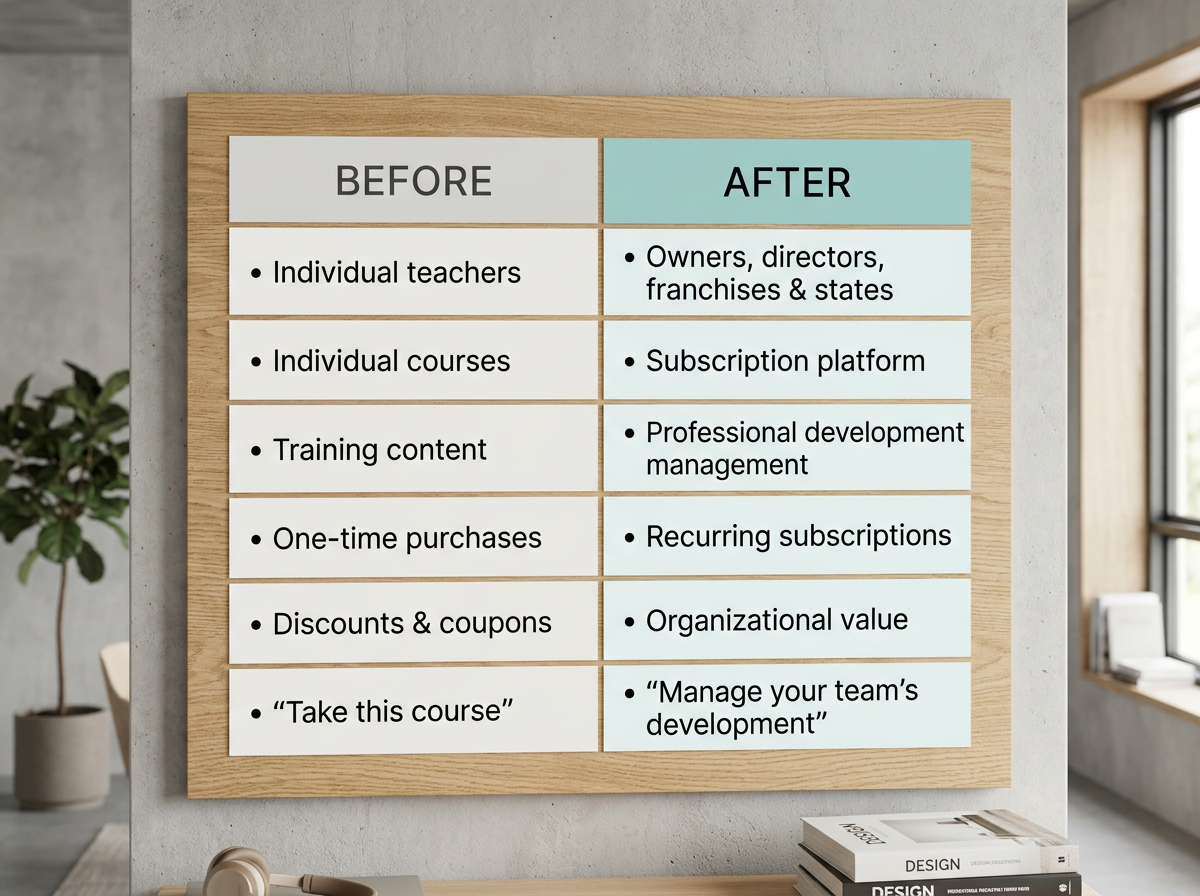
The original value proposition centered on the individual course:
Learn about child development—complete safety training. Meet your professional development requirements.
The new positioning centered on the organization:
Manage professional development across your team. Track requirements. Follow up with employees. Run reports. Keep everything in one place.
The underlying educational expertise was still valuable.
But the buyer, business problem, and value proposition had changed.
Instead of asking individual teachers to purchase one course at a time, the company could offer organizations a subscription-based system for managing professional development at scale.
BUILDING THE SOLUTION
Customer insight shaped more than the messaging.
The research didn't simply inform a new marketing campaign. Feedback from existing users helped identify opportunities to improve the learning management system itself.
The dashboard and user interface were updated to support owners and directors. Reporting capabilities and functionality were enhanced around the information organizational customers needed to manage their teams.
Marketing and product development reinforced one another:
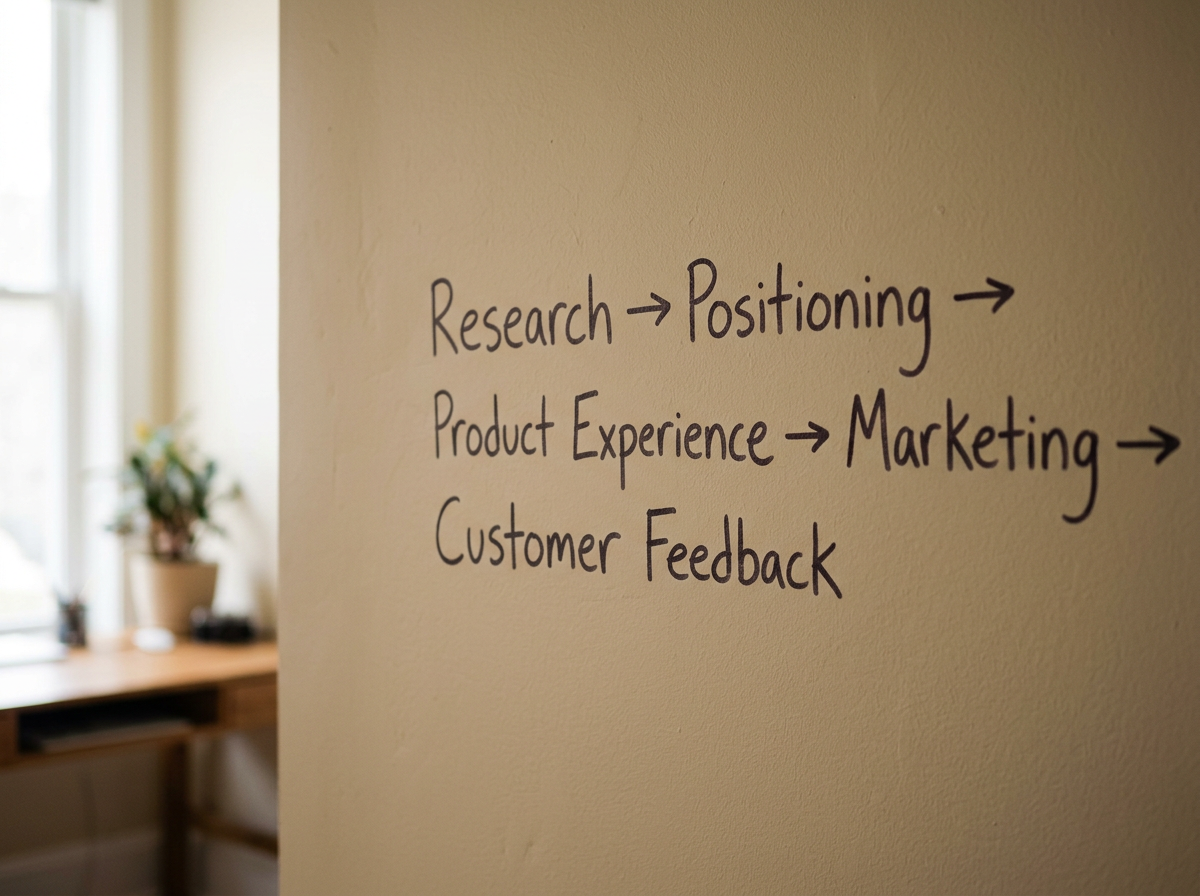
Research → Positioning → Product Experience → Marketing → Customer Feedback
The result was a solution that reflected the needs uncovered during the research process.
GOING TO MARKET
Build the marketing around how B2B customers actually buy.
Repositioning the product also required changing how we marketed and sold it.
The go-to-market approach expanded beyond individual course promotions to include:
Product demonstrations
Prospective customers could see the dashboard in action and understand how it could support their organization.
Website and landing pages
Messaging shifted toward owners, directors, and organizational decision-makers.
Video and product education
Videos and demonstrations showed customers how to use the platform and highlighted relevant functionality.
Email automation
We upgraded our email system to support more intentional customer education, communication, and renewal campaigns.
Industry events
Event strategy increasingly focused on audiences with greater purchasing authority, including owners and directors.
Government outreach
We proactively explored state-level opportunities to provide professional development at scale.
The company wasn't simply promoting the same product more aggressively.
It was building a B2B customer journey around a different buyer.
THE SYSTEM IN ACTION
Turning feedback into a better next show.
At one major industry trade show, the scope included coordinating approximately 40 internal team members, nine product applications, customer meetings, booth staffing, training, marketing materials, lead capture, and post-show follow-up. After the event, feedback identified several opportunities to improve scheduling, product coordination, and onsite execution.
That feedback didn't stop at just a post-show report. It became data points for the next year's planning.
Processes were refined. Responsibilities became clearer. Scheduling and training improved. Lead management became more standardized.
The result was a noticeably smoother event the following year, with overwhelmingly positive team feedback and significantly fewer areas identified for improvement.
Each show became an opportunity to make the next one better.
BEYOND ACQUISITION
Turning client relations into client success.
The strategy also expanded what counted as trade show success before, during, and after the event.
The company didn't have a traditional sales organization, which created another opportunity.
The existing client relations function evolved toward a more proactive client success model.
We provided FAQs, product information, videos, and other resources to help customers understand the subscription offering and identify expansion opportunities.
Renewal communications became more intentional, with defined timeframes and automated touchpoints supporting continued engagement.
The customer journey became more connected:
Awareness → Demonstration → Subscription → Adoption → Engagement → Renewal
Marketing wasn't simply responsible for generating the next transaction.
It helped support the entire customer lifecycle.
THE RESULTS
An existing product became a significant growth engine.
The subscription strategy contributed to multimillion-dollar growth, while recurring renewals created an increasingly valuable revenue stream. And that growth didn't require building an entirely new team or starting from scratch.
Many of the necessary assets already existed:
A strong library of professional development content
An existing learning management platform
Customer data
Internal subject-matter expertise
Existing subscription customers
A client relations team
The opportunity came from connecting those assets differently.
THE ORGANIZATION GAINED:
A clearer B2B buyer and value proposition
A scalable subscription-based offering
Strong recurring renewal opportunities
A product experience informed by customer research
More strategic product demonstrations and sales conversations
Marketing automation supporting adoption and renewals
A more proactive client success function
Greater alignment between customer needs, product development, and marketing
A business model capable of generating multimillion-dollar growth without proportionally increasing headcount
The biggest transformation wasn't the product. It was understanding where the value really lived.
The company could have continued spending more to promote individual courses, offering additional discounts and trying to convert an audience with limited purchasing power.
Instead, customer research revealed a more valuable opportunity.
The business already had most of what it needed.
What changed was who it marketed to, what problem it solved for them, and how the organization delivered that value.
Sometimes growth doesn't require more marketing.
It requires seeing the opportunity differently.
Ready to move marketing forward?
Complex Marketing Works Better With a System.
When an initiative involves multiple teams, competing priorities, deadlines, and many moving pieces, execution alone isn't enough.
Parks Evolution helps B2B organizations bring clarity, structure, and accountability to complex marketing initiatives, so teams spend less time clearing roadblocks and more time proactively moving the business forward.